
What a Half-Marathon Taught Me About Not Quitting
At first glance, you might think I’m a runner, but I can assure you the only place I’ve historically run to was my 8 a.m. Japanese class in college. Sure, I have what people might call a runner’s build and a decent amount of stamina, but I’ve never really been interested. Running always felt like a punishment disguised as a hobby. Why spend all that time out in the heat, sweating and gasping for air, when I could be inside doing literally anything else? And yet I found myself signing up for a half-marathon.
Running my first half-marathon felt like an acceptable challenge in my life at the time. Not a logical one—definitely not a well-prepared one—but an acceptable one. I had never run a distance even remotely close to 13.1 miles. In fact, I could count on one hand the number of times I had run voluntarily in the years leading up to it. Still, there was something about it that felt necessary.
A friend of mine at the time had previously run a full marathon, and I was deeply moved by her determination. She trained in the snow, in the heat, in conditions that would’ve convinced me to stay home without a second thought. Watching her push through that, day after day, awakened something in me—something that said, maybe you’re capable of more than you think. So we signed up together for the Route 66 Marathon, held each November in Tulsa. It felt official the moment we registered.
At first, I was excited. Optimistic, even. But as the race crept closer, that optimism slowly started to erode. Each passing day brought a little more doubt. Because the truth was, I hadn’t really trained. Not in any structured way. I hadn’t built the mileage. I hadn’t tested my limits. I hadn’t even figured out what I was supposed to wear, let alone how to pace myself over 13 miles. I started to realize that I might be in over my head. But by then, it was too late. Race day was coming whether I felt ready or not.
First held in 2006, Route 66 Marathon was designed to celebrate Tulsa’s connection to the historic Route 66 highway. The race winds through Tulsa’s neighborhoods, filled with live music, themed cheer stations and a kind of quirky energy that makes even first-time runners feel like they belong. Standing at the starting line, surrounded by hundreds—maybe thousands—of people who looked far more prepared than I felt, I had a moment of clarity: I had no idea what I was doing.
And just like that, it started. Taking that first step past the starting line was daunting. But there was also something exciting about it. The unknown had officially become reality, and there was no turning back now. I told myself I’d just take it one mile at a time. And surprisingly it wasn’t so bad.
I was enjoying myself. The energy of the crowd was contagious. There were runners everywhere—people of all ages, all paces, all with their own reasons for being there. Volunteers lined the course handing out water, snacks and occasionally things you wouldn’t expect during a race—like Bloody Marys. At one point, someone handed me a donut, and I accepted it without hesitation. It felt less like a race and more like a moving celebration. For a while, I forgot that I wasn’t supposed to be there.
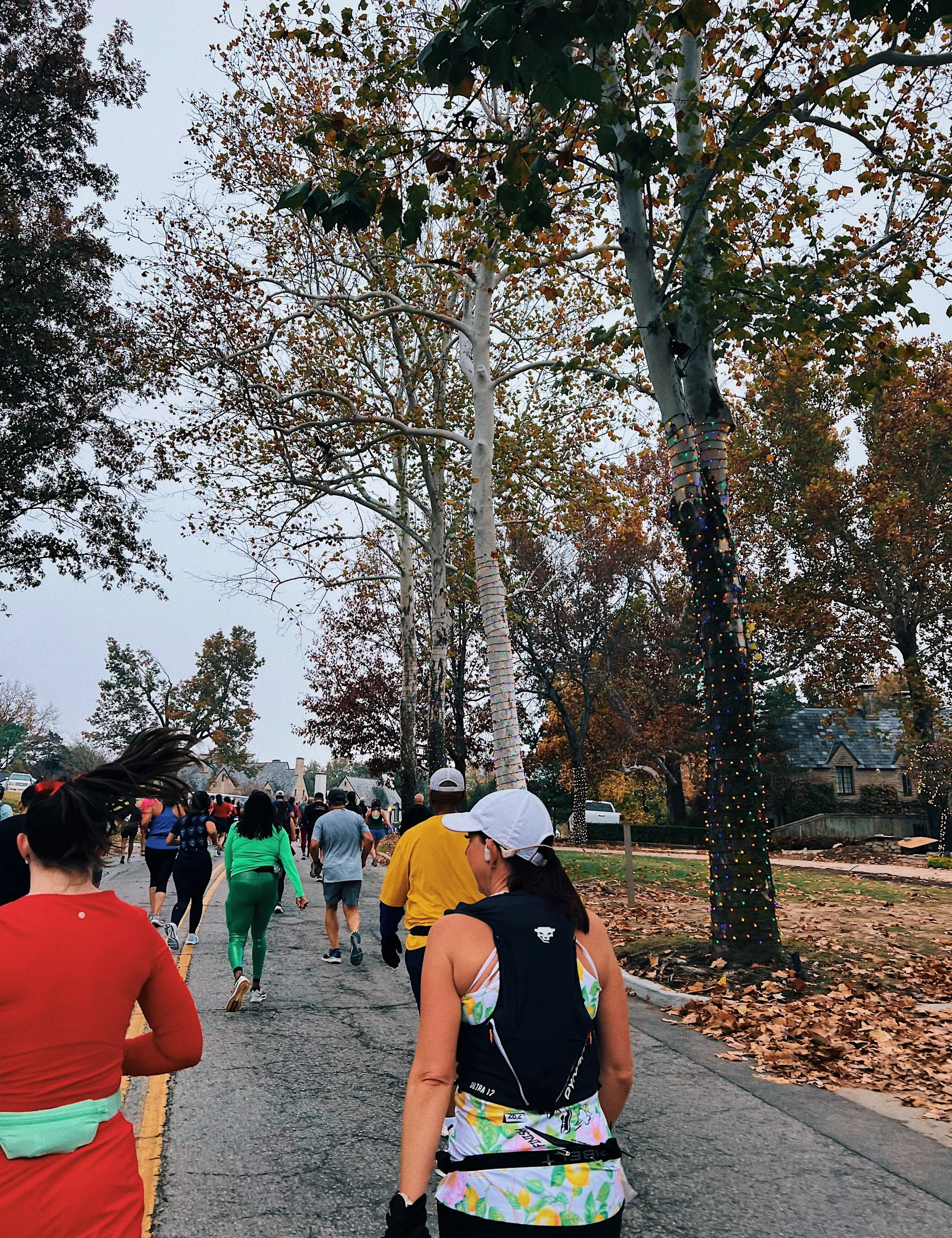
Runners competing in the Route 66 Marathon. (Kevin Severin)
But somewhere along the way—somewhere around mile eight—that feeling started to fade.
It began subtly. A small ache in my left leg. I told myself it was just a cramp. Something minor. But it didn’t go away. It got worse. I started stopping more frequently—every few minutes at first. Then more often. Each time I paused, I could feel the momentum slipping away. Not just physically, but mentally. The longer I stood still, the easier it became to imagine not finishing. And once that thought enters your mind, it’s hard to get rid of it.
I watched other runners pass me—some struggling, some steady, some walking. And for the first time all day, I started to seriously question whether I belonged out there at all. This wasn’t what I had imagined.
At some point, I found myself approaching a tunnel. The sunlight disappeared as I entered, and in the distance I could see the other side—a small, bright opening that felt much farther away than it probably was. Something about that image resonated with me. It perfectly captured where I was mentally: not at the beginning and not at the end, but in that difficult middle ground where the excitement wears off and the real work begins.
And standing there, in that moment, I realized something. If I kept stopping, I wasn’t going to finish, because I was giving myself too many opportunities to quit.
So I made a decision. No more breaks.
It wasn't a decision rooted in confidence or comfort. I still felt terrible. But I needed to break the pattern I had fallen into. Sometimes the plan you start with isn't the one that gets you across the finish line, and sometimes the only way forward is to stop negotiating with yourself.
So I kept going. Step after step. No stopping.
The pain didn’t disappear, but something else took over. Determination, maybe. Or stubbornness. At that point, it was hard to tell the difference. Time blurred together. The miles stopped feeling distinct. It was just movement.
Winston Churchill famously encouraged people to “never give in,” a mindset echoed in modern ideas about grit and perseverance.
An hour and a half later, I was still moving. I started passing people who had slowed down or shifted to walking. And while part of me felt encouraged by that, another part understood exactly how they felt. I had been there not long ago. But I couldn’t stop. Because I didn’t know if I’d be able to start again.
The finish line eventually came into view. First as a distant idea, then as something real. And in that final stretch, everything hit at once. The exhaustion. The relief. The disbelief.
I had done it. Not perfectly, not gracefully and certainly not according to plan, but I had finished. Standing there with that medal in my hand, none of the doubt that had followed me throughout the day seemed to matter anymore.
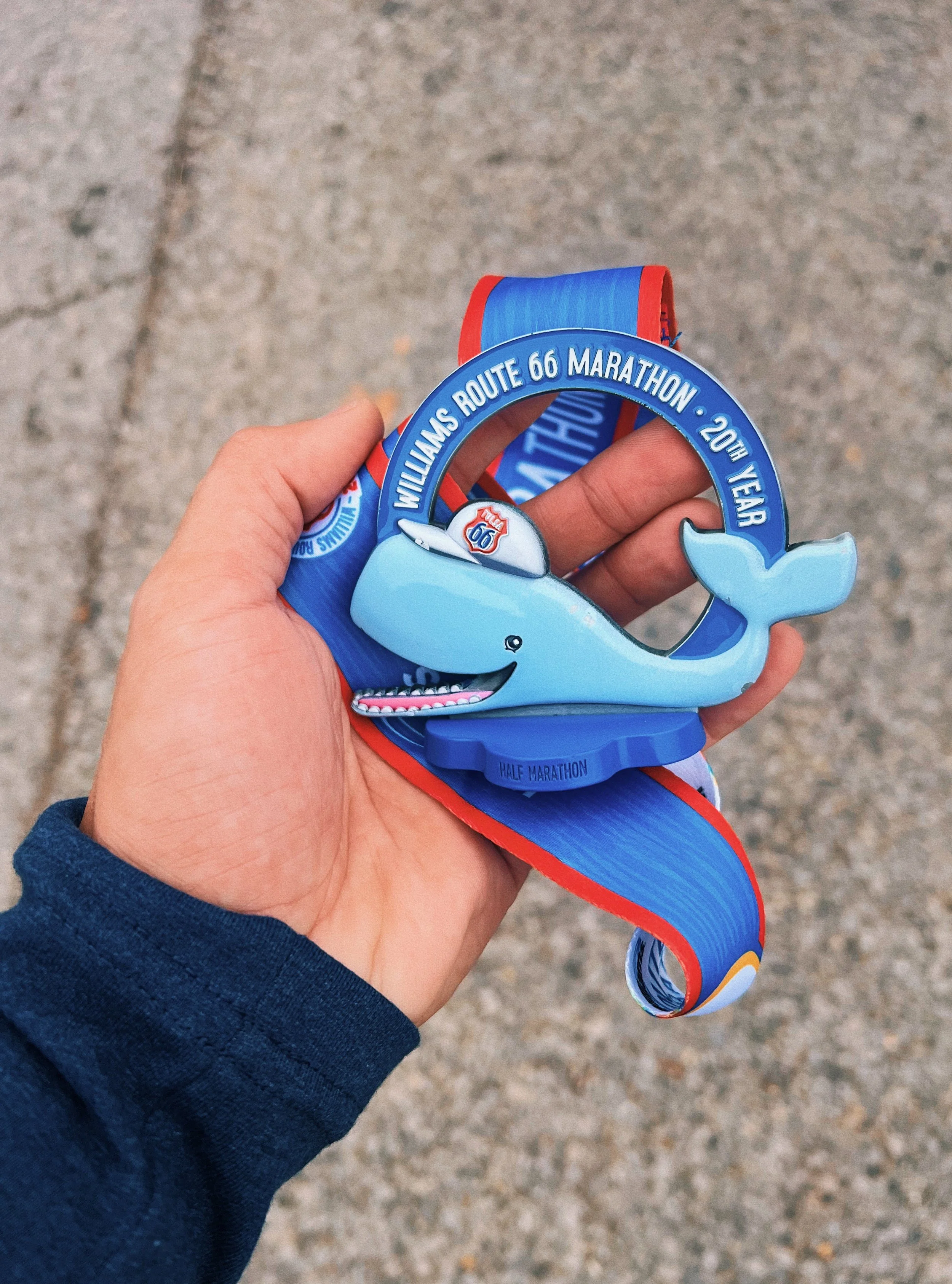
Me with my Route 66 Half-Marathon medal. (Kevin Severin)
I had proven something to myself. Not that I was a runner. But that I could keep going.
That race became a reference point—a reminder that there’s a difference between being unprepared and being incapable. I was unprepared., but I wasn’t incapable. And that distinction matters.
There are going to be moments in life where you feel like you’re in over your head. Where the plan falls apart. Where things don’t go the way you expected, and the easier option—the more comfortable option—is to stop. To take a break. To tell yourself you’ll try again another time.
But sometimes, that “other time” never comes.
Sometimes, the moment you’re in is the moment that matters. The one where you decide whether you’re going to keep going or not. Looking back, if I had stuck to my original “plan”—taking breaks, playing it safe, waiting until I felt better—I’m not sure I would have finished. I might have convinced myself that stopping was the smart choice. That quitting was justified.
And maybe it would have been. But I would have missed out on something important.
Because somewhere between mile eight and the finish line, something shifted. I stopped asking myself if I could do it, and started deciding that I would.
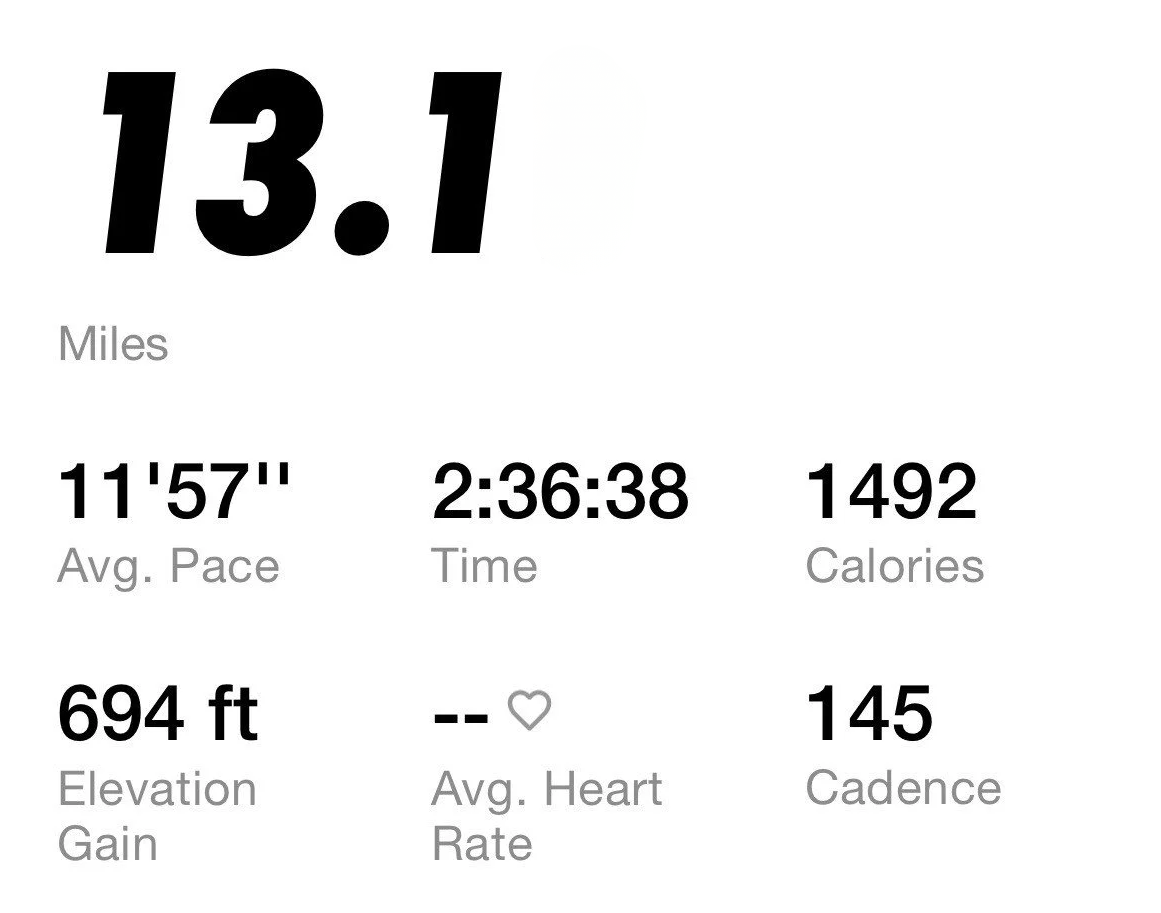
Kevin Severin's Half-Marathon statistics. (Kevin Severin)
Resilience sometimes looks like limping forward when every part of you wants to stop. Sometimes it looks like making a decision in the middle of a tunnel that no one else will ever see. A decision to keep going. Even when it hurts and even when you’re not sure how it ends. Even when you’re pretty certain you didn’t prepare well enough for it in the first place.
Most of us are running our own version of that race. We start with a plan. We hit a wall. We question ourselves. And somewhere along the way, we’re faced with a choice: Stop, or keep going.
The people who make it to the finish line aren’t the ones who had it all figured out from the start. They’re the ones who decided not to quit.
That’s what I learned from my first half-marathon.
Not how to run, but how to keep going.